American board of first responder behavioral healthcare (frbh)
National Standard for Occupational Psychological Hazard Protection (OPHP)
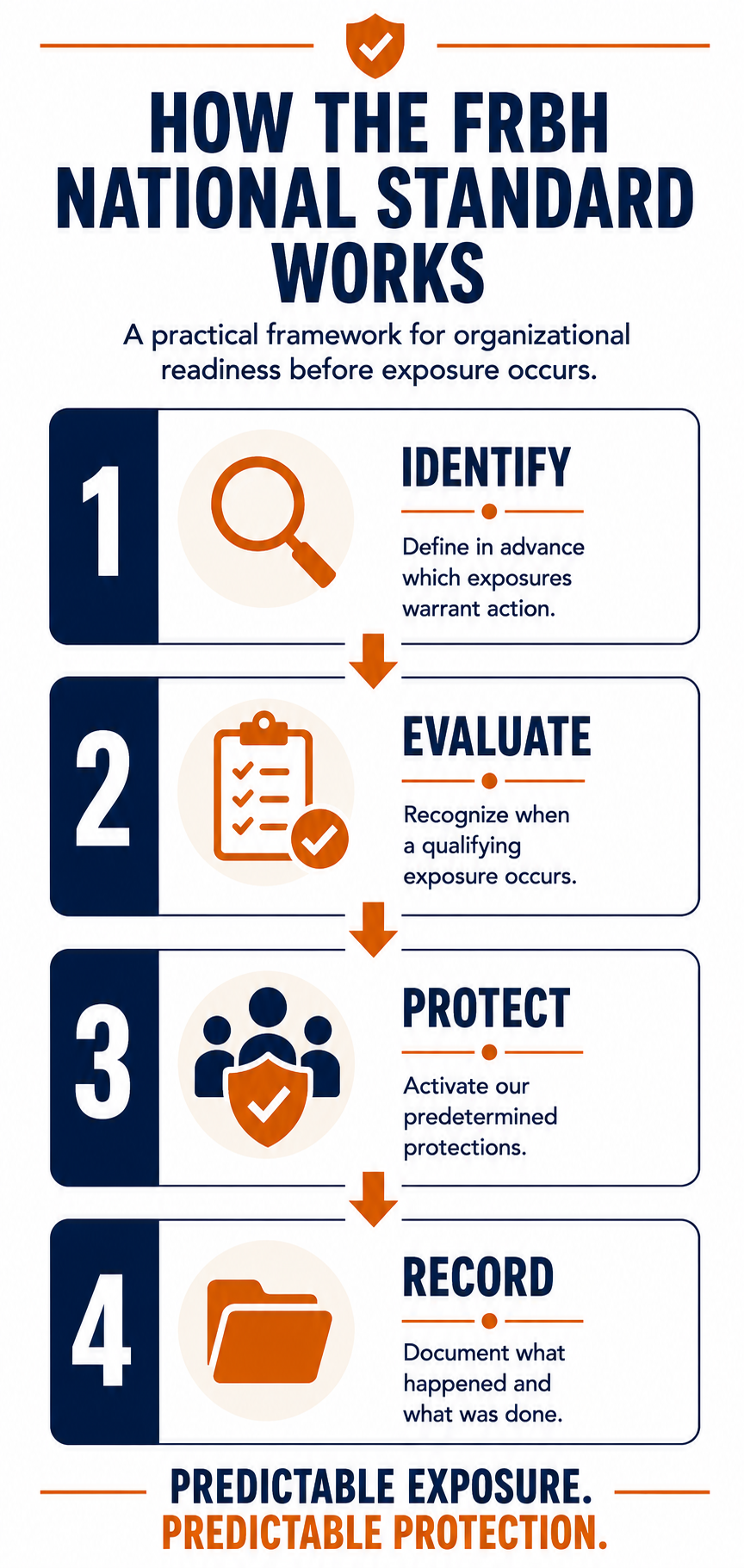
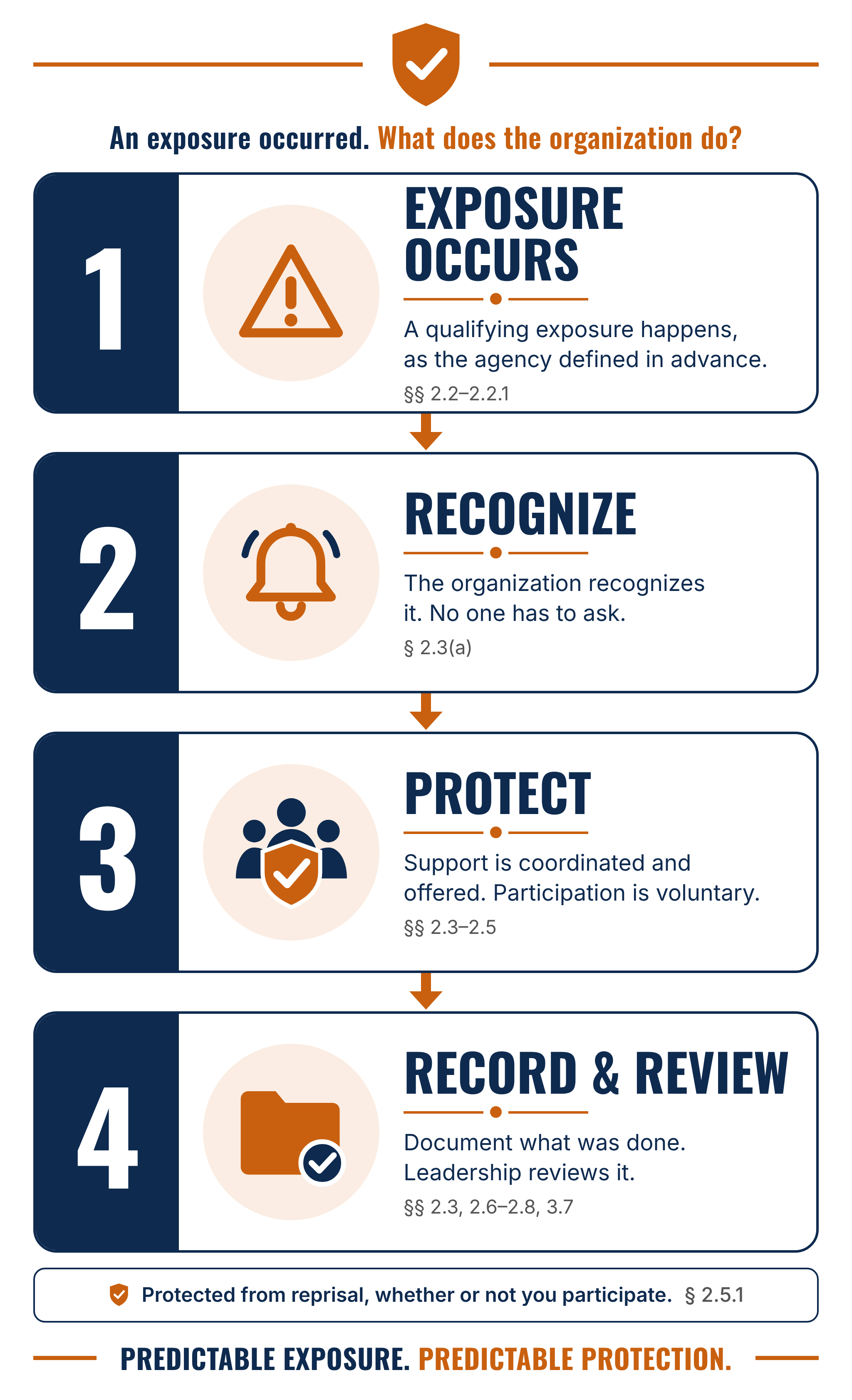
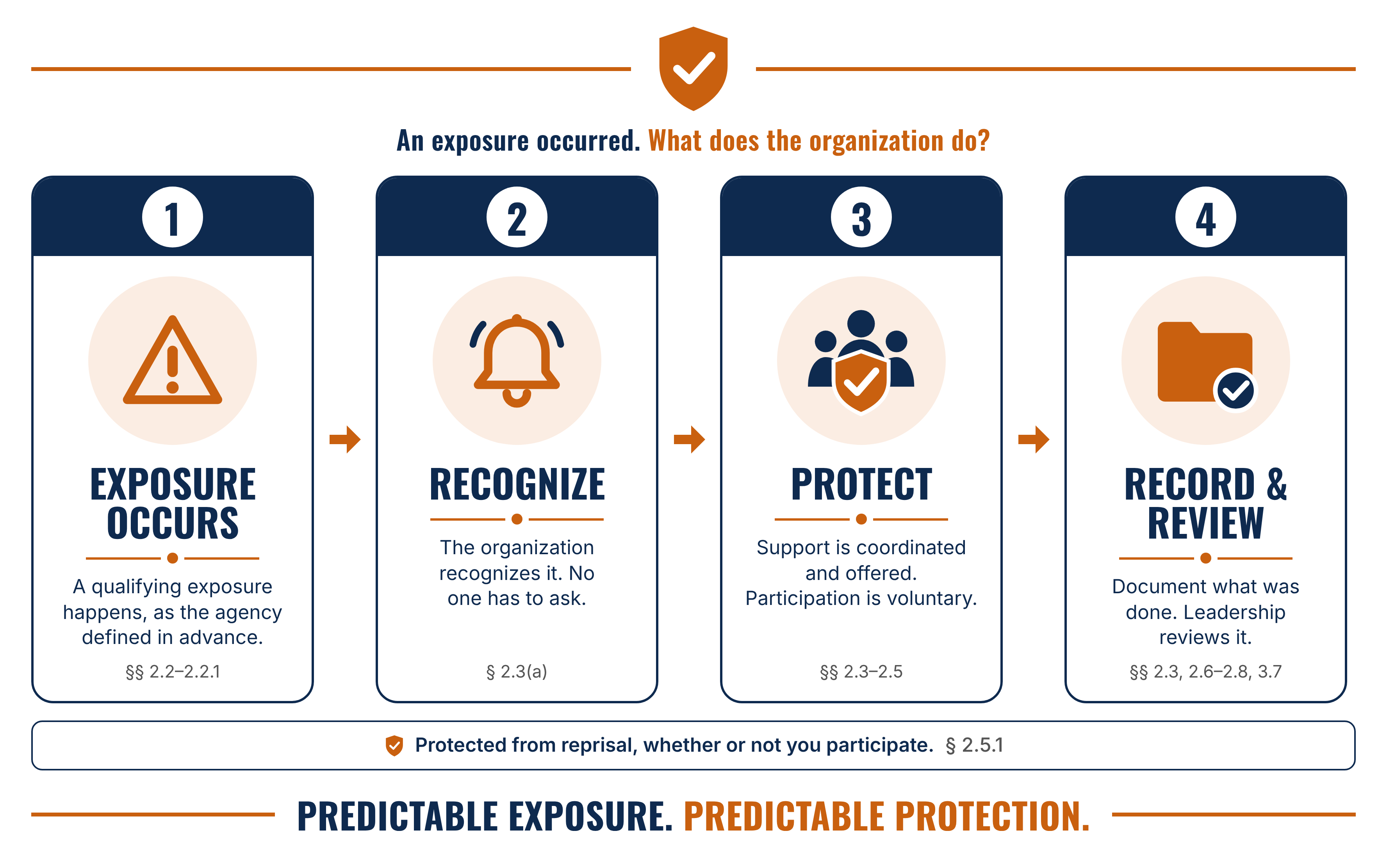
The FRBH National Standard for Occupational Psychological Hazard Protection (OPHP) is developed, adopted, and maintained by the American Board of First Responder Behavioral Healthcare (FRBH).
The Standard establishes nationally consistent organizational expectations for protecting public safety personnel following qualifying Occupational Psychological Hazard Exposure (OPHE). It defines expectations for governance, recognition and activation, workforce protection coordination, accountability, evaluation, and continual improvement.
DOWNLOAD THE NATIONAL STANDARD (PDF)
Published without charge. The Standard may be reproduced and distributed in unaltered form for the purpose of implementing it.
Foundational Principles
• Occupational Psychological Hazard Exposure is a foreseeable condition of public safety work.
• Predictable exposure requires predictable organizational protection
• Organizational responsibility begins with qualifying exposure, not individual symptoms, diagnosis, or disclosure
• Organizational protection does not require individual participation
• Personnel are protected from reprisal
• Governance establishes accountability
• Existing workforce protection capabilities are coordinated rather than replaced
• Organizational evaluation and learning strengthen protection over time
Basis in Occupational Safety Practice
Occupational safety systems establish organizational responsibility before individual harm becomes the sole basis for action. Defined criteria, assigned responsibility, documented processes, evaluation, and continual improvement create a systematic organizational response.
OPHP applies that organizational discipline at the point of qualifying Occupational Psychological Hazard Exposure.
The Standard does not assess hazards or work environments, prescribe how work should be designed or staffed, or establish measures intended to prevent or reduce occupational exposure. Its focus is what the organization does when qualifying exposure has occurred.
The Standard is informed by established occupational safety principles and is complementary to broader occupational health and psychosocial-risk frameworks. Conformity with the FRBH National Standard does not require conformity with any other standard or framework.
Structure of the Standard
Chapter 1 — Foundational Concepts.
Definitions, core principles, scope, and the relationship of OPHP to existing occupational safety and workforce protection approaches.
Chapter 2 — Organizational Expectations.
Normative requirements addressing governance, qualifying OPHE criteria, recognition and activation, workforce protection coordination, confidential access and protection from reprisal, leadership oversight, organizational evaluation, continual improvement, and conformity.
Chapter 3 — Conformity.
Self-assessment requirements, defined review intervals, evidence sufficiency, determination rules, and nonconformity classification.
Chapter 4 — Legal and Regulatory Interface.
Implementation considerations involving applicable confidentiality, privacy, disability, workers' compensation, collective bargaining, and public-records requirements.
Chapter 5 — Revision and Maintenance.
Review cycle, change transparency, version designation, and continuity of the Standard.
Chapter 6 — Requirements for Conformity Assessment Bodies.
Requirements applicable to any future independent conformity assessment body, including independence, competence, evidence, confidentiality, impartiality, and complaints. FRBH does not perform conformity assessment, certification, or accreditation.
Annexes A through I. Evidence examples, implementation considerations, relationships to existing capabilities, illustrative exposures, basis and rationale, field-validation status, revision history, implementation resources, and unresolved development questions.
Applicability
The Standard applies to public safety organizations whose personnel encounter Occupational Psychological Hazard Exposure as a foreseeable condition of their work.
It applies to personnel who encounter OPHE in the course of duty regardless of sworn status, licensure, employment classification, or whether their role is field-based, including full-time and part-time personnel, volunteers, telecommunications personnel, and support personnel.
🚒 Fire Service
🚑 Emergency Medical Services (EMS)
🚔 Law Enforcement
📞 Public Safety Communications / Dispatch
🔒 Corrections
🌲 Wildland Fire
🌪️Emergency Management
🏛️ Federal Public Safety Organizations
Scope and Limits
The National Standard establishes organizational expectations for protecting personnel following qualifying Occupational Psychological Hazard Exposure.
The Standard begins at the point of exposure.
It does not assess hazards or work environments, determine how work should be designed or staffed, evaluate assignment practices, or establish measures intended to prevent or reduce exposure.
The Standard does not establish clinical standards, prescribe treatment, require a particular behavioral health program or provider, evaluate individual psychological condition, make fitness-for-duty determinations, or maintain employee medical records.
It does not claim to prevent post-traumatic stress disorder (PTSD) or any other psychological or medical condition.
Conformity
Organizations currently determine their own conformity with the Standard through self-assessment in accordance with Chapter 3.
Conformity must be supported by objective evidence but requires no external approval, fee, purchase, or third-party assessment.
FRBH does not perform conformity assessment, certification, or accreditation and does not operate such a program.
LEARN ABOUT CONFORMITY→
Standards Governance and Development Status
Version 3.1 of the FRBH National Standard is published as a Provisional Field-Test Edition and supersedes Version 3.0.
The FRBH Board of Directors serves as the standards adoption authority during the provisional period. The National Advisory Council provides multidisciplinary subject-matter expertise in a non-voting advisory capacity.
The Standard is available for voluntary implementation while FRBH continues field validation, stakeholder participation, public comment, and standards development toward an open multi-stakeholder consensus process.
Comments are accepted at info@frbh.org and are welcome from any organization or interested party, whether or not they intend to adopt the Standard.
Implementation Support
General implementation support for voluntary implementation of the National Standard is available without charge through the FRBH National Technical Assistance Center.
FRBH does not provide organization-specific consulting, assess hazards or work environments, recommend exposure controls, or determine organizational conformity.
VISIT NTAC→